
Workers and America 250

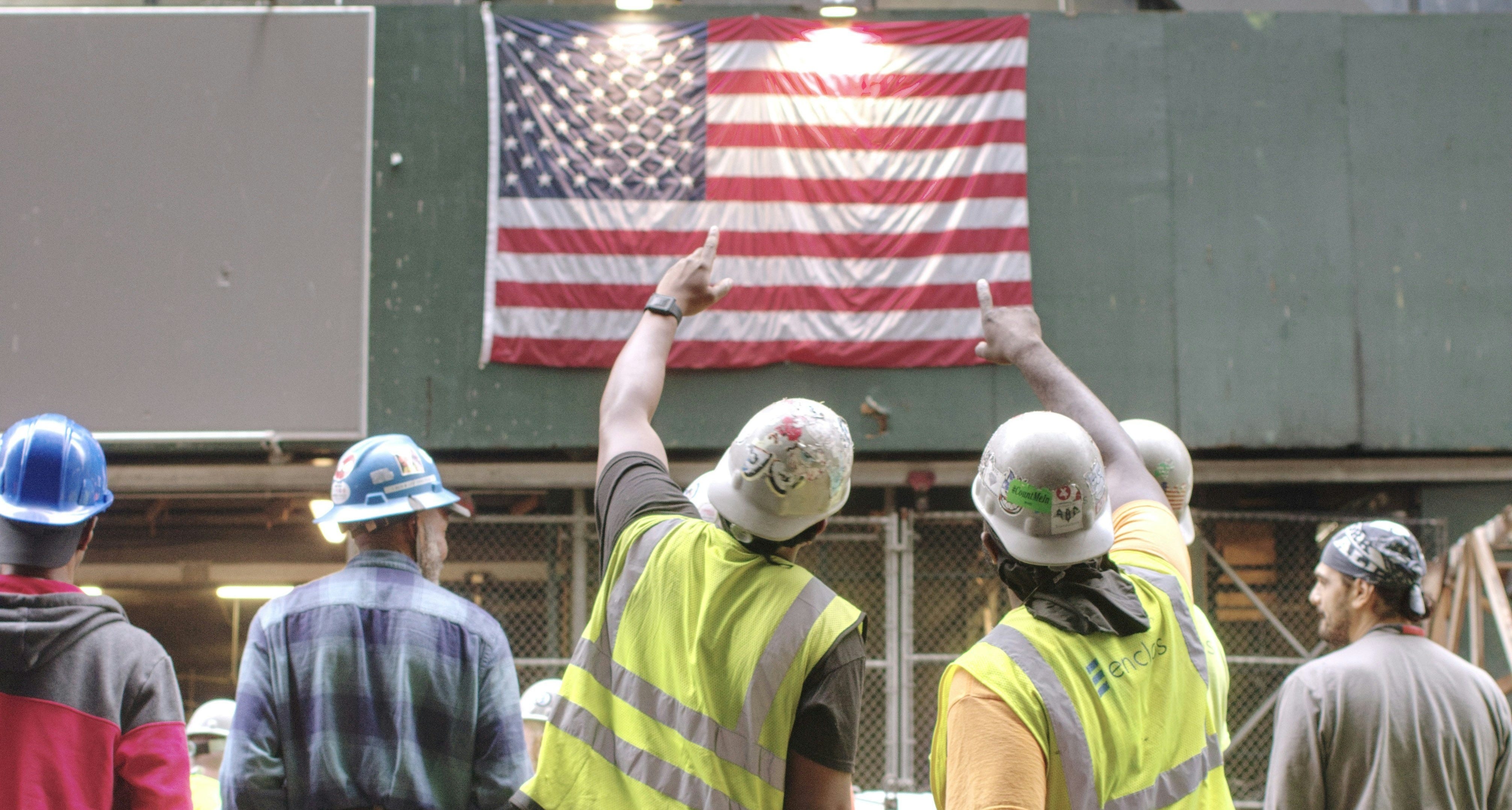
America turned 250 years old. Not very long in historical terms. In a relatively brief time, much has happened. Beginning with a radical declaration, “all men are created equal” (even with the contradictory and dehumanizing restrictions on Black people and women), the nation made up of immigrants from everywhere became an economic colossus and an imperfect democratic system: “government of the people, for the people, by the people.” What is meant by “We the people” has always been a contested term. Still is. But doesn’t need to be.
In the lead-up to the country’s July 4th celebration, there were a plethora of inspirationally diverse and at times, competing interpretations of how a semiquincentennial story should be told. I was most attentive to the ones that focused on who should be included in the narrative and, importantly, what was put forward as the driver of America’s evolution. America as an idea and physical materiality (a country with borders, called the “United States”) didn’t just happen. Despite contradictory founding mythologies and self-serving claims of our nation’s identity, the country hasn’t been imagined; it’s been made. I don’t mean “made” as a metaphorical way of thinking about America (e.g., “Give me your tired, your poor, your huddled masses yearning to breathe free,” or “city on a hill”). I mean, “made” as constructed; as a place where people live, function, and develop as human beings.
Instead of debates about whether America was at birth “God’s blessing to liberty” or a deeply flawed, exploitative land, our celebratory patriotic odes should have asked but mostly didn’t, “Who made America?” The answer is so obvious to be largely unseen and taken for granted: workers. Whether indentured, enslaved, or free, for two and a half centuries the country has only taken shape as a livable space where, regardless of our dueling founding mythologies, individuals could prosper, and communities could thrive, because people endlessly labored.
America’s historical advancement has depended on constantly solving the “labor question.” The “question” has three primary constituent parts that can be applied to any period: Who is going to do the work? How is their labor power going to be secured? And who sets the price for their labor power?
The first answer has included in the past native inhabitants, indentured servants, and enslaved people. Today, the labor force is made up of immigrants, children, prison labor, and U.S.-born adult men and women who don’t own sufficient land or capital to otherwise make a living.
Regarding the second question, the answer relied on indentured servitude, slavery, peonage systems, child labor, immigration, human trafficking, “free” wage labor (non-union and union), sharecropping, educational institutions, and independent contracting.
And the answer to the third question? Slave owners, planters and merchants, post-Civil War landowners, prisons, industrial employers (i.e., capitalists), the workers (i.e., through labor unions), and by the 20th century, the state (i.e., wage laws, employment and labor laws).
A truthful history of America’s endurance would acknowledge how it was built and whose labor was appropriated. The colonists first attracted Europeans of modest means who agreed to come to the colonies to work as indentured servants for five to seven years with an employer. But indenturing proved too uncertain, small-scale, and increasingly costly. So, landowners turned to African slaves as a more profitable and renewable source of labor.
Beginning in 1619, enslaved workers built a national economy that by the mid-1800s was largely derivative of southern cotton production. Cotton exports made America a manufacturing powerhouse. By 1850, the total slave population in the United States was over 3.2 million, and cotton production was the linchpin to the buying and selling of human beings. In 1861, at least 410 billion hours of unfree labor was consumed by slave owners. That same year, The Economist explained the United States had become an international economic force because the plantation owners’ “labor has hitherto been abundant, unremitting and on the increase.” Southern apologists for slavery argued for retaining the forced labor of Black people because the slaves could do the undignified but necessary work, freeing up White workers to do more respectable jobs.
After a deadly Civil War, and the passage of the 13th, 14th, and 15th Amendments stripped large planters of their property rights in human flesh, “huddled masses” of immigrants by the millions came to America. They came by invitation from industrialists and government to feed the emergent factory system’s insatiable need for physically demanding labor. In two massive waves from 1840 to 1919, 34 million foreign-born people came to the United States. Since 1965, roughly 70 million immigrants have come to America. They immigrated from poverty, lack of economic opportunity, wars, and persecution. But mostly, they came eager to work and did so in mills, mines, factories, retail shops, restaurants, hospitals, offices and on farms, coastal ports, waterways, roads, railways and construction sites. American capitalism found a new human form to extract labor from; legally free but reduced to “wage labor.”
As the American industrial workforce swelled, corporate chiefs violently fought against unionization. Until 1935, wage laborers had no national law recognizing their right to organize into labor unions. The Wagner Act (formally known as the National Labor Relations Act) empowered private sector workers to form and join unions, which they did immediately by the millions. The 1960s and ‘70s expanded worker rights to cover government and educational employment. Today, America has more than 14 million labor union members. But there are also 26 states that have anti-union “right-to-work” laws suppressing worker power.
And that brings us to President Trump’s “Great American State Fair.” All of the “right-to-work” states participated in this celebration of America’s 250th birthday. Over sixteen days of programming, the Fair promises “an unforgettable celebration of the people and traditions that define our nation.” Each day, according to the website program, has a different theme: architecture, agriculture, the creative arts, military service, health, technology, faith, machines, culture, education, community, and entrepreneurs. But other than mentions of creative workers (e.g., musicians), there are no references to mechanics, carpenters, engineers, steelworkers, coal miners, laborers, tailors, teachers, farmers, sanitation workers, nurses, doctors, firefighters, or police officers. While workers draw up the building plans, there are no architects. We have schools that magically educate students without teachers. We have powerful car engines but apparently no automobile workers to manufacture and install them. However, the fair does honor “entrepreneurs, manufacturers, financiers.” Hell, machines (the embodied labor of other workers) get three mentions, but they seem to operate autonomously.
And what about the institution that is most responsible for not only building the middle class, allowing for broad-based prosperity and democratizing the world of work? Hint: it’s labor unions. Not a single word.
The U.S. Labor Department website does salute the American worker. Not the labor movement, however. But its expression of gratitude is nothing more than a litany of obsequious and dishonest claims of Trump’s accomplishments for working people. Again, the workers are left on the periphery of American history instead of where they belong - at the core.
Yes, I know, we have an annual day to thank labor and mark the end of summer. But its creation was designed to deny and inhibit the power of America’s working class, not genuinely celebrate it. And left out of our 4th of July storytelling, workers are reduced to minor characters behind soldiers, entrepreneurs, bankers, and founding fathers.
In 1935, Bertolt Brecht’s poem, “A Worker Reads History,” reveals the cognitive dissonance that working-class folks feel when their participation in history is erased.
Who built Thebes of the 7 gates?
In the books you will read the names of kings.
Did the kings haul up the lumps of rock?
And Babylon, many times demolished,
Who raised it up so many times?
In what houses of gold glittering Lima did its builders live?
Where, the evening that the Great Wall of China was finished, did the masons go?
Great Rome is full of triumphal arches.
Who erected them?
During his first Congressional Address, President Abraham Lincoln defined the parameters of how America would “solve the labor question” and function as a nation by rhetorically asking, “whether it is best that capital shall hire laborers, and thus induce them to work by their own consent, or buy them and drive them to it without their consent.”
It has been in some variation these two distinct labor systems that have defined and propelled America’s development from July 4th, 1776 to July 4th, 2026. Arrayed on a continuum from unfree to free, workers have always been empirically at the center of our history. Just rarely ever the hero of the American narratives that are meant to define us as one people. And yet, it is our most basic shared human activity of doing work that binds us into a universal class.
What the competing narratives of America at 250 demonstrate is that we are not a people with a shared understanding and experience of democracy. It wasn’t the case in 1776 that it was “self-evident that all men are created equal.” After two and a half centuries of struggle to create a more equal and inclusive society, as a set of rules and values for co-existing, we hold to at best a polarizing idea of democracy. But our creative life activity has literally constructed America and provided conditions for human flourishing. Labor is everywhere mixed with nature. We have produced our own American existence.
In the same speech to Congress, Lincoln famously states that “Labor is prior to and independent of capital. Capital is only the fruit of labor, and could never have existed if labor had not first existed. Labor is the superior of capital, and deserves much the higher consideration.” Imagine then an American celebration of its founding and history by centering the people whose labor has made everything not gifted to us purely by nature from “the mountains to the prairies, to the oceans white with foam”?
In the closing pages of his1941 novel, Out of This Furnace, Thomas Bell writes the following reflection of what it means to be an American from an eastern European steelworker whose family has worked for many years in Braddock, Pennsylvania:
“Made in the U.S.A., he thought... If I’m anything at all I’m an American, only I’m not the kind you read about in history books or that they make speeches about on the Fourth of July; anyway, not yet… Maybe not the kind of American that came over on the Mayflower, or the kind that’s always shooting off their mouths about Americanism and patriotism, including some of the God damndest heels you’d ever want to see, but the kind that’s got ‘Made in U.S.A.’ stamped all over them, from the kind of grub they like to the things they wouldn’t do for all the money in the world… But it wasn’t where you were born or how you spelled your name or where your father come from. It was the way you thought and felt about certain things. About freedom of speech and the equality of men and the importance of having one law - the same law -for rich and poor, for the people you liked and the people you didn’t like… About the uses to which wealth and power could honorably be put… About human dignity, which helped a man live proudly and distinguished his death from an animal’s.”
Now, maybe this is how left and right, red and blue, Democrats and Republicans find genuinely shared truths to be self-evident.
well said -- sharing on the ILHS FB page
Excellent piece, Bob! Will definitely share.